
Influencer rate card India 2026: what to charge for a reel
Typical 2026 rates by follower count, a simple formula for your own price, and how to handle usage rights, exclusivity and "can you do it for free?"
The first time a brand asks “what are your rates?”, most creators panic and type a number that feels safe. Usually it’s too low, and that number then follows you into every future deal with that brand.
This guide gives you a starting point: what Indian creators are typically charging in 2026, a simple formula to work out your price, and the extras you should never give away for free.
A quick caveat: rate cards are averages. Your niche, engagement and audience location matter more than follower count. Treat the ranges below as a sanity check, not a rule.
Typical rates in India by follower count
Published 2026 rate cards for Indian creators cluster around these ranges for a single sponsored Instagram post or reel:
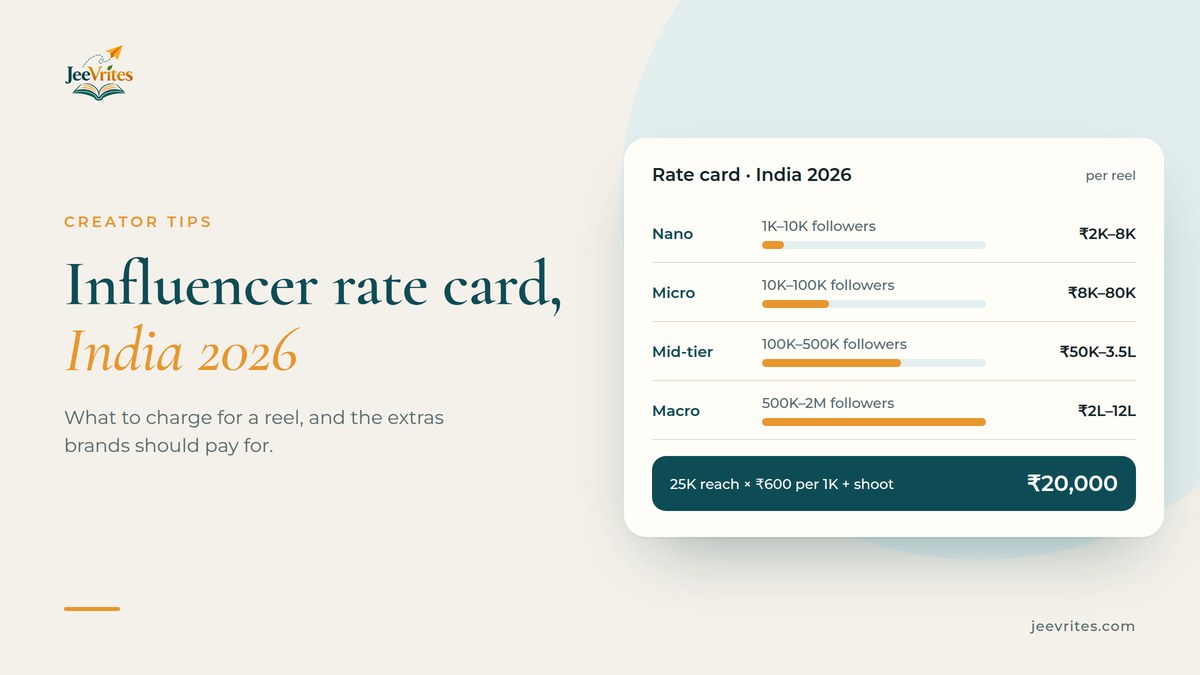
| Tier | Followers | Typical rate per post |
|---|---|---|
| Nano | 1K–10K | ₹2,000–₹8,000 |
| Micro | 10K–100K | ₹8,000–₹80,000 |
| Mid-tier | 100K–500K | ₹50,000–₹3.5 lakh |
| Macro | 500K–2M | ₹2 lakh–₹12 lakh |
Source: upGrowth influencer pricing guide, India 2026.
The ranges are wide for a reason. A micro creator with 15K followers in personal finance can out-earn a 60K lifestyle account, because finance audiences are valuable to brands and harder to reach.
A formula for your own price
Instead of picking a number from the table, build your price from three things you can actually measure.
1. Start from your average reach. Open your last 10 reels in Instagram Insights, note the accounts reached, drop the highest and lowest, and average the rest.
2. Multiply by a rate per 1,000 people reached. For most Indian niches, ₹300–₹800 per 1,000 is a reasonable starting band. Use the top of the band for finance, tech, B2B, beauty and parenting. Use the bottom for broad entertainment and memes.
3. Adjust for engagement and effort. If your saves and comments are well above your niche’s usual, go up. If the brief needs a shoot, props, a location or a script approval round, add for your time.
Here’s an example. Your average reach is 25,000, you’re in a tech niche at ₹600 per 1,000, and the brief needs a full scripted shoot:
- Base: 25 × ₹600 = ₹15,000
- Scripted shoot, two revision rounds: +30% = ₹19,500
- Round to a clean number on your rate card: ₹20,000 per reel
That sits comfortably inside the micro range, and you can explain exactly how you got there if a brand asks.
The extras brands often ask for
A rate is for one post on your account. Everything beyond that is extra, and brands expect to pay for it. Typical add-ons from the same rate cards:
| Extra | What it means | Typical add-on |
|---|---|---|
| Usage or repost rights | The brand reposts your content on its own pages | +25% to +40% |
| Ads or whitelisting | The brand runs paid ads using your content or handle | +60% to +120% |
| 30-day exclusivity | You can’t work with competing brands for a month | +30% to +50% |
| 90-day exclusivity | The same, for three months | +80% to +150% |
| Reel + story + feed bundle | Three formats in one campaign | 1.6× to 2× the single rate |
If a brief mentions “perpetual usage” or “all rights”, stop and price it separately or ask to limit it to a period, for example 3 or 6 months.
How to say your rate (and handle “we have no budget”)
Send a short, confident reply. Don’t apologise for your price.
Thanks for reaching out! For one reel with a story share, my rate is ₹20,000. That includes one revision round and 30 days of organic reposting on your page. Paid ad usage and exclusivity are quoted separately. Happy to send my media kit.
When a brand says it has no budget, you have three honest options:
- Decline politely and ask to be considered for paid campaigns.
- Offer a smaller deliverable, such as one story instead of a reel, for a lower fee.
- Accept product only when you would genuinely buy it anyway and it fits your audience. Say clearly that it’s a one-off.
Get paid, every time
Pricing well means nothing if invoices slip. Before you start any deal, confirm in writing: deliverables, posting date, usage period, payment amount, and payment terms (for example, 50% before posting and 50% within 15 days after). Then track every deal from pitch to payment so nothing is forgotten. Our guide on tracking brand deals in Notion shows a simple setup.
Want the system ready-made?
The Creator Brand Deal OS is a Notion workspace for exactly this: a deal pipeline from Pitched to Paid, deadline labels that update themselves, a payment tracker, a content calendar linked to each brand, plus a media kit page, a rate card calculator and pitch emails. It works on Notion’s free plan.
Planning the content around your deals? Read how to plan a month of content in Notion.